When Nanocoatings Fail: The Stubborn Gap Between Laboratory Promise and Field Reality
For more than a decade, the materials science community has heralded nanocoatings as a near-definitive answer to one of industry's most expensive and persistent problems: corrosion. The American Society of Civil Engineers has long estimated that corrosion costs the U.S. economy upward of $270 billion annually, a figure that spans infrastructure, defense hardware, commercial shipping, and industrial equipment. Nanocoatings — ultrathin films engineered at the molecular level to form impermeable, chemically resistant barriers — appeared poised to slash that number dramatically. In university laboratories from MIT to Georgia Tech, the results were genuinely remarkable. Accelerated salt-spray tests, electrochemical impedance measurements, and simulated UV degradation studies all pointed toward coatings that could outlast conventional epoxies and polyurethanes by orders of magnitude.
Then the coatings went to sea. And into the sky. And the story changed.
A Controlled Environment Is Not the Real World
The core issue, as researchers are increasingly candid about admitting, is that laboratory testing protocols were never designed to replicate the full complexity of real-world operating environments. A nanocoating applied to an aircraft fuselage panel does not experience a single, stable stressor. It experiences thermal cycling from sub-zero cruising altitudes to scorching tarmac temperatures, mechanical flexing as airframe components expand and contract, hydraulic fluid exposure during maintenance, and prolonged UV bombardment at high altitude — often simultaneously. Maritime applications introduce their own compounding variables: biological fouling from microbial communities, fluctuating salinity levels across different ocean zones, and the relentless mechanical abrasion of wave action.
"We optimized these coatings for the conditions we could measure and control," explains Dr. Renata Osei, a materials chemist at a naval research laboratory on the East Coast who has spent the past three years analyzing failed coating samples retrieved from decommissioned patrol vessels. "What we did not fully account for was the synergistic interaction between stressors. Salt alone, or UV alone, or mechanical wear alone — any one of those we can handle. It is the combination, occurring in unpredictable sequences, that degrades the nanostructure far faster than our models predicted."
The Structural Culprit: Interfacial Adhesion
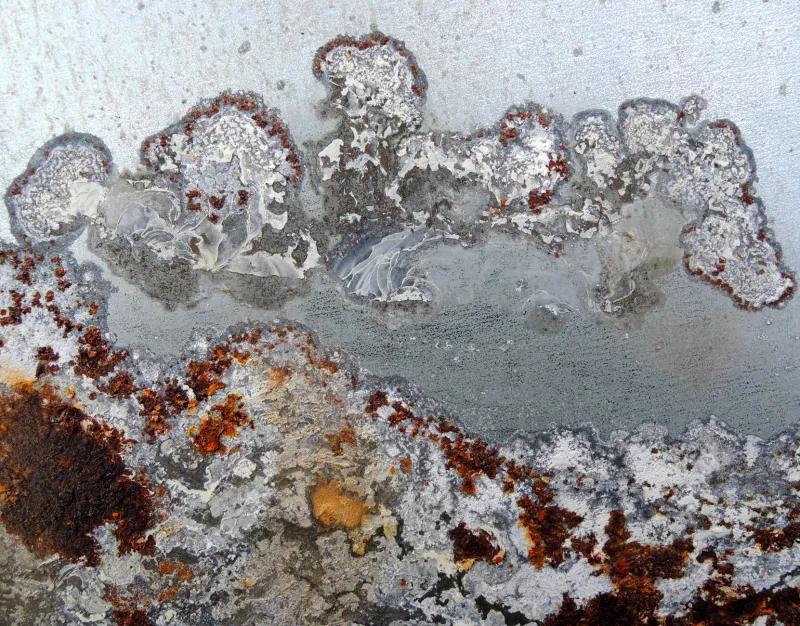
When scientists examine failed nanocoatings under electron microscopy, a recurring pattern emerges. The coating itself — whether it is a cerium oxide nanoparticle-doped matrix, a graphene-enhanced polymer film, or a silane-based nanocomposite — frequently retains much of its intrinsic integrity. The failure is not happening within the coating. It is happening at the interface between the nanocoating and the underlying substrate.
Interfacial adhesion, the molecular bonding between a coating and the metal surface it is meant to protect, has emerged as the single most underestimated variable in field performance. In the laboratory, substrates are meticulously cleaned, chemically pretreated, and maintained under humidity-controlled conditions prior to coating application. In a naval shipyard in Norfolk, Virginia, or on a maintenance apron at a commercial airport in Atlanta, those conditions are rarely replicable. Surface contamination, ambient humidity fluctuations during application, and minor surface oxidation that occurs in the minutes between surface preparation and coating deposition can all compromise the interfacial bond at the nanoscale — weaknesses that may be invisible during initial quality checks but propagate catastrophically under cyclic stress.
"The bond energy at the interface needs to exceed a threshold that accounts not just for static adhesion but for dynamic fatigue," says Dr. Marcus Tran, a professor of materials engineering at the University of Michigan whose research group has developed a new class of functionalized silane adhesion promoters specifically designed to improve nanocoating durability. "Most commercial nanocoating formulations were not engineered with that fatigue threshold in mind. They were engineered for maximum barrier performance, which is a different optimization target entirely."
The Aerospace Industry's Mounting Concerns
For aerospace manufacturers and their supply chain partners, the underperformance of nanocoatings carries consequences that extend well beyond laboratory disappointment. The Federal Aviation Administration mandates rigorous corrosion control programs for commercial aircraft, and several major carriers had begun integrating nanocoating technologies into their maintenance cycles as a means of extending inspection intervals and reducing downtime. Early results from those programs have been mixed at best.
Boeing and Airbus have not publicly disclosed specific data on nanocoating field performance, but industry insiders — speaking on background — indicate that several nanocoating products initially approved for use on structural components have been quietly returned to evaluation status following reports of earlier-than-expected degradation in humid, tropical operating environments. The Gulf Coast and Southeast Asia routes, where aircraft experience intense humidity and temperature swings multiple times daily, have proven particularly punishing.
The U.S. Navy's surface fleet has encountered comparable challenges. Nanocoatings applied to hull sections and topside structures have demonstrated acceptable performance in temperate Atlantic operating zones but have shown accelerated failure rates in the high-salinity, high-UV environment of the Pacific theater. Program managers at the Naval Sea Systems Command have reportedly initiated a reassessment of nanocoating procurement specifications to incorporate more rigorous field-simulation testing requirements before acquisition approval.
What the Next Generation Must Deliver
The scientific community is not standing still. Several research directions are gaining momentum, each aimed at closing the gap between laboratory performance and operational durability.
Self-healing nanocoatings represent one of the most promising avenues. By embedding microencapsulated corrosion inhibitors or polymerizable agents within the coating matrix, researchers are developing systems that can autonomously repair minor damage before it propagates to the substrate. Groups at Northwestern University and at the Army Research Laboratory in Aberdeen, Maryland, have published encouraging results demonstrating that coatings incorporating halloysite nanotube carriers — which release inhibitors in response to pH changes triggered by corrosion chemistry — can dramatically extend service life under simulated field conditions.
Another approach focuses on adaptive surface chemistry. Rather than engineering a static barrier, researchers are developing coatings whose surface energy and chemical reactivity shift in response to environmental triggers. Titanium dioxide nanoparticle systems that exploit photocatalytic activity to continuously refresh hydrophobic surface properties under UV exposure are one example currently under investigation.
Perhaps most critically, the field is beginning to invest in improved testing methodologies. The American Society for Testing and Materials is reportedly working with industry consortia to develop new standardized protocols that incorporate multi-stressor, sequential degradation testing — moving away from single-variable accelerated tests toward more faithful simulations of the complex, overlapping exposures that coatings actually encounter in service.
The Investment Question
The stakes of solving this problem are substantial. The global market for nanocoatings is projected to exceed $15 billion by the end of the decade, with corrosion protection representing the largest single application segment. U.S. federal agencies — including the Department of Defense, the Department of Energy, and the National Science Foundation — have collectively directed hundreds of millions of dollars toward nanocoating research over the past fifteen years. That investment is not without return; the fundamental science has advanced considerably. But translating that science into coatings that perform reliably across the full range of conditions industry demands will require a more honest accounting of where the current generation of products falls short.
As Dr. Osei puts it: "The laboratory success was real. The chemistry works. What we are learning now is that engineering for real-world deployment requires a different kind of rigor — one that embraces complexity rather than simplifying it away. That is harder work, but it is the work that actually matters."
For the engineers and scientists who will design the next generation of corrosion-resistant nanomaterials, that is both a sobering assessment and a precise definition of the challenge ahead.