Precision Without Permission: The Long Wait for Surgical Nanorobotics to Leave the Laboratory
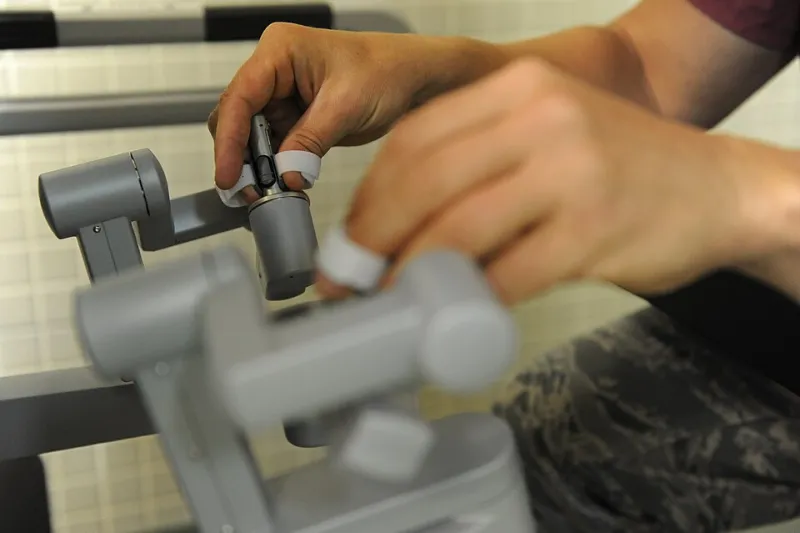
Photo: Kemberly Groue, Public domain, via Wikimedia Commons
For nearly three decades, research journals have published stunning demonstrations of nanorobotic systems capable of navigating biological tissue, delivering targeted therapeutic payloads, and performing mechanical interventions at the cellular level. The imagery is compelling: submicron machines threading through capillaries, drilling into tumor membranes, or repairing arterial lesions with a precision no human hand could replicate. Yet as of 2025, no surgeon in an American operating room has ever deployed an FDA-approved nanorobotic device in a living patient. The distance between laboratory spectacle and clinical deployment remains vast—and largely unacknowledged in mainstream technology coverage.
This is not a story about science failing. The underlying research has, by many measures, succeeded. It is a story about the formidable institutional, economic, and technical barriers that accumulate between a proof-of-concept and a regulated medical device—barriers that are, in the case of nanorobotics, unusually severe.
What "Nanorobotic Surgery" Actually Means
The term nanorobotics is used loosely across academic and popular literature, which itself contributes to public confusion about the field's actual status. In the most rigorous engineering sense, a surgical nanorobot is an autonomous or semi-autonomous device operating at the nanometer to micrometer scale, capable of performing a defined mechanical or biochemical task within a biological environment. This distinguishes true nanorobotic systems from drug-loaded nanoparticles—which are passive delivery vehicles—and from minimally invasive surgical robots such as the da Vinci system, which operate at the macroscale.
True nanorobotic surgical platforms face a categorically different set of design challenges than either of those adjacent technologies. They must generate or harvest sufficient energy to function inside the body, navigate complex fluid dynamics at low Reynolds numbers, communicate position and status to external operators, and perform reliably in an environment that actively attempts to neutralize foreign materials through immune response.
The Regulatory Vacuum
The FDA's current medical device classification framework was not designed with autonomous submicron machines in mind. Nanorobotic surgical systems occupy an ambiguous regulatory space that does not map cleanly onto existing device categories. Depending on their mechanism of action, such devices might be classified as combination products—part device, part drug, part biologic—triggering a multi-center review process that can extend timelines by years and multiply compliance costs by orders of magnitude.
The agency has issued guidance documents on nanotechnology in general, and its 2014 and 2022 frameworks acknowledged the distinct properties of nanoscale materials. However, no dedicated regulatory pathway exists for devices that are both nanoscale in construction and robotic in function. Developers must therefore negotiate classification with FDA reviewers on a case-by-case basis, introducing unpredictability that investors and corporate sponsors find deeply unattractive.
This regulatory ambiguity has a chilling effect that extends well beyond the compliance calendar. When a startup or research consortium cannot tell prospective investors how long FDA review will take or under which framework it will occur, the risk calculus becomes prohibitive. Several promising nanorobotic research programs at American universities have stalled not because the science stopped working, but because the commercialization pathway became too uncertain to attract the capital needed to fund preclinical trials.
Engineering Constraints That Remain Unsolved
Beyond regulatory structure, genuine technical barriers persist. Energy supply remains among the most stubborn. Nanorobotic devices operating inside the human body cannot be tethered to external power sources in most envisioned surgical applications. Proposed solutions—including ultrasonic energy harvesting, chemical fuel cells using endogenous glucose, and magnetically induced propulsion—each carry significant limitations in power density, biocompatibility, or controllability.
Navigation presents a second unresolved challenge. Real-time imaging of nanoscale devices within biological tissue requires either contrast agents that raise their own toxicological questions, or imaging modalities with spatial resolution insufficient for precise localization. Magnetic resonance imaging can track magnetically actuated nanorobots in some experimental configurations, but the technique has not yet demonstrated the sub-millimeter positional accuracy that surgical precision demands.
Biocompatibility compounds both problems. The materials capable of performing mechanical work at the nanoscale—carbon nanotubes, certain metal alloys, piezoelectric ceramics—frequently elicit immune responses or carry cytotoxicity profiles that require extensive mitigation before they can be introduced into a surgical field. Each mitigation strategy adds mass, complexity, and potential failure modes.
The Economics of a Market That Does Not Yet Exist
Venture capital investment in nanorobotics has historically been episodic and shallow. The sector lacks the near-term revenue milestones that institutional investors require to justify the capital exposure associated with decade-long development timelines. Unlike a novel cancer immunotherapy, which can demonstrate measurable patient outcomes in phase-two trials within three to five years, a nanorobotic surgical system must first demonstrate safety in animal models, then in cadaveric studies, then in limited human trials—each phase requiring new regulatory interactions and new rounds of financing.
Large medical device companies, which might otherwise absorb early-stage nanorobotics ventures through acquisition, have shown limited appetite for assets whose path to revenue remains structurally undefined. The result is a funding gap between the academic laboratory and the clinical trial phase that few nanorobotics programs have successfully bridged.
The National Institutes of Health and the National Science Foundation have funded foundational nanorobotics research generously by historical standards, but federal grant structures are not optimized for the sustained, iterative engineering work required to move a prototype through preclinical validation. Academic incentives further compound this misalignment: publication of a novel nanorobotic mechanism earns a researcher career advancement; the grinding work of biocompatibility testing and sterilization protocol development does not.
What Would Change the Equation
Several structural interventions could meaningfully accelerate nanorobotic surgery's transition from laboratory to clinical setting. A dedicated FDA regulatory pathway—analogous to the Breakthrough Device Designation but specifically architected for autonomous nanoscale systems—would reduce investor uncertainty and allow development programs to plan compliance strategies in advance rather than negotiating them mid-development.
Concentrated federal investment in translational nanorobotics infrastructure, including shared preclinical testing facilities and standardized biocompatibility assessment protocols, would reduce the redundant costs that each individual development program currently bears independently. The Defense Advanced Research Projects Agency has funded nanorobotic research under programs related to battlefield medicine and autonomous wound management; a civilian-facing analog through NIH or the Advanced Research Projects Agency for Health could serve a similar catalytic function.
Finally, the field would benefit from a more disciplined public narrative. Overpromised timelines and breathless press releases have repeatedly inflated expectations and then disappointed them, eroding the credibility of serious researchers and making the patient capital that nanorobotics requires harder to secure. Honest communication about what remains unsolved—and what genuine progress looks like—is not a concession to pessimism. It is a prerequisite for building the sustained institutional commitment that will eventually bring these devices into operating rooms.
The science is not the obstacle. The architecture of translation is.