Invisible Imports: The Foreign Nanotech Precursors Quietly Powering America's Most Critical Industries
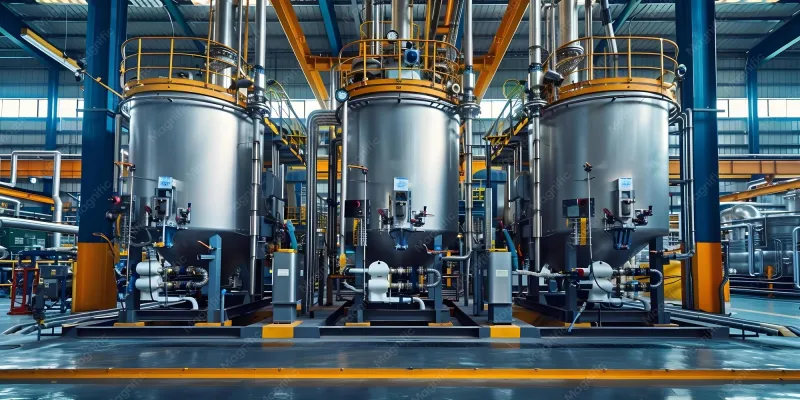
Photo: industrial supply chain nanomaterials manufacturing facility chemical production, via img.freepik.com
When policymakers discuss supply chain vulnerability in advanced manufacturing, the conversation typically centers on finished semiconductors, rare earth elements, or battery-grade lithium. These are legitimate concerns, and the legislative responses they have generated—from the CHIPS and Science Act to the Inflation Reduction Act's domestic content provisions—reflect a genuine recognition that strategic dependencies require strategic remedies. What those conversations consistently omit, however, is the layer of material inputs that sits upstream of the chips, the batteries, and the aerospace composites: the engineered nanomaterials and nanoparticle precursors without which none of those finished products can be manufactured at competitive scale.
This is the supply chain nobody talks about. And it may be the one that matters most.
The Nanomaterial Layer of Advanced Manufacturing
Modern semiconductor fabrication depends on nanoscale materials at multiple points in the production process. Chemical mechanical planarization slurries—used to smooth wafer surfaces between deposition steps—contain precisely engineered cerium oxide and silica nanoparticles whose size distribution and surface chemistry must be controlled to tolerances measured in nanometers. Extreme ultraviolet photoresists incorporate nanostructured metal-oxide clusters that define pattern resolution at the leading edge of process technology. Atomic layer deposition precursor chemicals, used to deposit films one atomic layer at a time, are synthesized from specialty organometallic compounds that require rare or controlled-access starting materials.
In the battery sector, cathode active materials for lithium-ion cells are nanostructured composites whose electrochemical performance depends critically on particle morphology at the nanoscale. Nickel-manganese-cobalt and lithium iron phosphate cathode powders are manufactured through hydrothermal and co-precipitation processes that require high-purity precursor salts—lithium hydroxide, cobalt sulfate, nickel sulfate—whose global supply is dominated by a small number of producers, most of them operating in China, the Democratic Republic of Congo, and Indonesia.
Aerospace and defense manufacturers similarly depend on nanomaterial inputs. Carbon nanotube-reinforced composites, nanostructured thermal barrier coatings for turbine blades, and nanoparticle-modified adhesives for structural bonding all require specialty materials that American producers supply only in limited quantities.
Where the Materials Come From
China's dominance in the nanomaterial precursor space is not accidental. It reflects two decades of deliberate industrial policy, including subsidized production capacity, preferential export pricing, and strategic acquisition of raw material assets in Africa, South America, and Southeast Asia. Chinese producers currently account for the majority of global output of several nanomaterial categories that American manufacturers cannot easily replace: fumed silica, cerium oxide polishing particles, battery-grade lithium hydroxide, and precursor chemicals for atomic layer deposition processes.
This concentration is not limited to China. Germany and Japan supply critical specialty chemicals used in semiconductor nanofabrication, including certain photoresist components and ALD precursors. South Korea dominates production of some cathode precursor materials. Taiwan, through its integrated semiconductor supply ecosystem, is the origin point for nanostructured dielectric films and packaging materials used in advanced chip assembly.
The difference between dependence on allied nations—Germany, Japan, South Korea, Taiwan—and dependence on geopolitically adversarial suppliers is significant but should not be overstated. Allied supply chains can be disrupted by natural disasters, industrial accidents, export controls imposed for domestic political reasons, or cascading shortages triggered by demand spikes in third markets. The COVID-19 pandemic demonstrated that geographic concentration of any critical input creates vulnerability regardless of the political alignment of the supplying country.
Why Reshoring Has Stalled
Several structural factors explain why domestic nanomaterial production has not kept pace with American manufacturing ambitions, even as federal policy has prioritized supply chain resilience in adjacent sectors.
First, nanomaterial production is chemically and technically complex in ways that resist rapid capacity expansion. Building a domestic source of battery-grade cerium oxide nanoparticles or semiconductor-grade CMP slurry is not simply a matter of constructing a facility and hiring workers. It requires years of process development, specialized equipment, and a workforce with expertise that American technical education has not historically prioritized at scale.
Second, the economics of nanomaterial production are challenging for domestic manufacturers. Chinese producers benefit from lower labor costs, subsidized energy, and supply chain integration with upstream raw material sources that American competitors cannot easily replicate. A domestic producer of, say, nickel sulfate precursor for battery cathodes would face structural cost disadvantages that no tariff structure has yet fully offset.
Third, the policy attention devoted to nanomaterial supply chains has been disproportionately low relative to their strategic importance. The CHIPS Act allocated substantial funding for semiconductor fabrication but comparatively modest resources for the upstream material inputs that fabs require. The Department of Energy's battery supply chain initiatives have addressed some cathode precursor vulnerabilities but have not comprehensively mapped or targeted the full spectrum of nanomaterial dependencies across manufacturing sectors.
The Geopolitical Risk Calculus
The strategic implications of nanomaterial import dependence extend beyond simple cost and availability concerns. In a scenario involving significant deterioration of US-China relations—whether triggered by Taiwan Strait tensions, technology export disputes, or broader economic decoupling—Chinese export restrictions on nanomaterial precursors could impose immediate production constraints on American semiconductor fabs, battery manufacturers, and defense contractors.
China has demonstrated willingness to use critical material exports as geopolitical instruments. Its 2010 restriction of rare earth exports to Japan following a maritime dispute established a precedent. More recent export controls on gallium and germanium—both used in semiconductor manufacturing—signal continued readiness to deploy material supply as a strategic tool. There is no structural reason to assume that nanomaterial precursors would be treated differently in a more acute confrontation.
The defense implications deserve particular attention. Several nanomaterials used in advanced weapons systems, stealth coatings, and energetic materials have no commercially available domestic substitutes at production scale. A sustained supply disruption could degrade manufacturing capacity for systems that the Department of Defense considers essential to near-peer deterrence.
Toward a Coherent Nanomaterial Supply Strategy
Addressing this vulnerability requires a more systematic approach than the sector-specific interventions currently in place. A comprehensive national nanomaterial supply chain audit—identifying critical inputs, mapping current sourcing, and quantifying concentration risk—would provide the factual foundation that effective policy requires. Such an audit does not currently exist in public form, and its absence means that policymakers are making strategic manufacturing investments without full visibility into upstream dependencies.
Beyond assessment, targeted investment in domestic nanomaterial production capacity—structured through the kind of loan guarantees and offtake agreements that the Department of Energy has used to support battery cell manufacturing—could improve the economic viability of reshoring for priority materials. International supply chain diversification agreements with allied nations could reduce concentration risk without requiring full domestic self-sufficiency in every material category.
The nanomaterial supply chain is not invisible because it is unimportant. It is invisible because it is small, technical, and unglamorous. Correcting that misperception is among the more consequential things American industrial policy could do in the years ahead.